
This is a research briefing for residential aged care managers about how they can best support rainbow residents. It was developed with consultation from Mark Henrickson. Mark is a former professor of Social Work at Massey University, who authored many studies into sexuality and gender identity in older adults in New Zealand, including with residential aged care.
Executive Summary
This briefing is intended primarily for residential aged care managers, and it sets out what the evidence shows about facilities' current preparedness to support Rainbow residents and what managers can practically do in response. Beyond the ethical case, facilities that cannot demonstrate inclusive care for a growing proportion of older New Zealanders carry real reputational and commercial risk. For many Rainbow residents, sexuality and gender identity are a core part of who they are and how they have lived, and thus no facility can genuinely claim to deliver person-centred care without recognising such diversity.
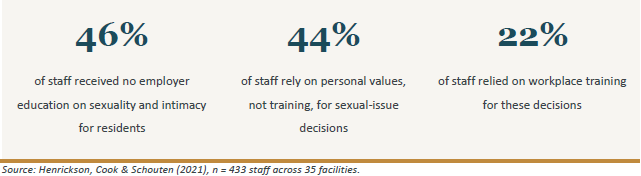
New Zealand's aged care sector is not adequately prepared for a resident population that will include growing numbers of Rainbow people. A study conducted across 35 facilities found that fewer than half of staff had received any employer education on sexuality and intimacy for residents, and that only 22% of participants relied on workplace training to make decisions on sexual issues while 44% based decisions on personal values (Henrickson et al., 2021). Another study found subtle and overt forms of homophobia across facilities, with care staff broadly unprepared to provide culturally appropriate care to LGB residents (Neville et al., 2015).
This is despite sexual orientation having been named as a dimension of cultural safety since 1996 (Richardson & Carryer, 2005). Without explicit policy and leadership within individual facilities, the standards Registered Nurses are trained to cannot, on their own, produce consistent practice.
Research suggests residents who anticipate or experience non-acceptance conceal their identities and experience worse mental health outcomes as a direct consequence (McMullen-Roach et al., 2025). New Zealand-based studies document that residents themselves, including heterosexual individuals otherwise supportive of Rainbow identities, look to staff to set the tone on what's acceptable for discussion (Henrickson et al., 2021).
Context
New Zealand's population is ageing, and the proportion of people who openly identify as Rainbow continues to grow. The residential aged care sector will serve increasing numbers of residents whose life histories and relationships differ from those assumed by traditional models of care that presume residents are heterosexual and cisgender. Facilities that describe themselves as culturally competent and person-centred have an opportunity to ensure that this extends to gender and sexually diverse residents as consistently as it does to other groups. Some facilities will have already been doing parts of this well, but implementation is, in large part, inconsistent.
“Older LGBTI+ people in long-term care routinely respond to anticipated or actual non-acceptance by concealing aspects of themselves, describing this as a survival strategy.”
McMullen-Roach et al. (2025)
A meta-analysis of 193 studies found that greater concealment of one's sexual orientation was associated with higher levels of internalising mental health problems, including depression, anxiety, psychological distress, and problematic eating (Pachankis et al., 2020). A systematic scoping review of 42 studies in the United Kingdom found that experiences of discrimination across the lifecourse weakened the personal networks of older LGBT people, which in turn increased reliance on formal care services and raised the risk of social isolation and loneliness. However, often LGBT people are faced with spending later life in homophobic care environments, described as “providing the very antithesis of ‘care’”, with 20 separate studies identifying formal care as a primary site of health and wellbeing inequity for older LGBT people (Kneale et al., 2021, p. 506).
Many Rainbow older adults came of age when same-sex attraction was criminalised or carried serious professional and social risk. Homosexuality was decriminalised in New Zealand only in 1986, and habits of discretion accumulated across a lifetime do not stop when individuals enter care facilities (Henrickson et al., 2021). Research with older gay men in New Zealand found that the majority were concerned their sexual orientation would not be recognised and that providers would be discriminatory towards them in a residential setting (Kushner et al., 2013).
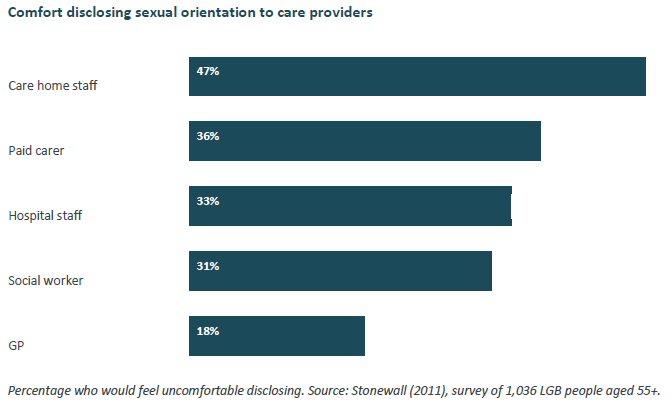
New Zealand data on many specific measures remain limited; however, data from the UK, which has comparable legal and cultural histories and social acceptances of same-sex relationships, can help offer insight into what the pattern is likely to look like in a New Zealand context. Survey data from over a thousand LGB people over 55 found that nearly half would not feel comfortable disclosing their sexual orientation to care home staff, the highest figure across all health and care providers surveyed and more than double the 18% recorded for GPs (Stonewall, 2011).
Rainbow older adults were also nearly twice as likely as heterosexual peers to expect to rely on formal support services as they age (Stonewall, 2011). One likely reason is that most informal care in later life comes from partners and adult children. However, gay and bisexual men over 55 are nearly three times more likely to be single than heterosexual men (40% versus 15%), and only around a quarter have children, compared with nearly nine in ten heterosexual men and women (Stonewall, 2011). Thus, the sector will increasingly serve people who need it more but also fear it more.
Is New Zealand Aged Care Prepared?
Sexual orientation and gender identity have been named as dimensions of cultural safety within the Registered Nurse scope of practice since 1996, alongside ethnicity, religion, and disability (Richardson & Carryer, 2005). Registered Nurses are responsible for ensuring that those to whom they delegate care tasks also practise in culturally safe ways (Neville et al., 2015). Yet two of the New Zealand studies this briefing describes, conducted in 2015 and 2021, both found the same pattern of discomfort and unpreparedness among staff. Whatever cultural safety training has achieved over that period, it has not been sufficient on its own to produce consistent practice.
Part of the reason may be a lack of a trained workforce, as care workers make up approximately 53% of the aged care workforce and carry no formal training requirement, meaning much of the frontline workforce has no guaranteed exposure to this content at all (Neville et al., 2015). Further, the Henrickson et al. (2021) national study found fewer than half of 433 staff respondents had received any employer education on sexuality and intimacy for residents. The study's authors also noted a likely positive response bias, since participating facilities were probably more informed than those that declined and therefore sector-wide figures are likely worse.
Focus group research with 47 care workers across seven Auckland residential care facilities found that staff who had gay or lesbian family members, friends, or colleagues tended to be more comfortable with the prospect of caring for LGB residents (Neville et al., 2015). However, same-sex affection was generally kept behind closed doors, and some staff said they were only comfortable with it when it could be read as platonic. For example, a hug or a kiss between two women would be described as unremarkable, while the same gesture between two men was expected to draw attention.
When residents expressed homophobic attitudes toward LGB peers, staff attributed this to the generation they had grown up in rather than recognising that explaining behaviour as generational effectively excused it and sustained an environment that presumed heterosexuality. Staff also described a general lack of knowledge in working with residents who were not heterosexual (Neville et al., 2015).
Without explicit organisational procedures, staff default to personal, cultural, or religious values when they encounter issues relating to residents' sexuality and relationships (Henrickson et al., 2021). A treat-everyone-thesame approach, the antithesis of person-centred care, places the burden of disclosure onto Rainbow residents, requiring them to correct the presumption of heterosexuality with no organisational support (Willis et al., 2016; Simpson et al., 2018, p. 871). Research in the Netherlands found that inclusive practice could not be sustained by individual advocates without broader support, including explicit policy and leadership that signals the issue matters (Leyerzapf et al., 2018).
Recommendations
While many care facilities have established many of the following recommendations, there are many more where this work is limited or yet to begin.
Create opportunities for disclosure at intake
Revise assessment and care-planning processes so that all residents are asked about significant relationships and identity through open-ended questions that do not presume heterosexuality. Not asking is not a neutral position, and it instead may force Rainbow residents to make unsupported disclosures if they wish to be known accurately. Note this directly follows from person-centred care, as it means finding out what may matter to the resident specifically rather than assuming it.
Add a short session on inclusive language to induction
Across studies, Rainbow older adults in long-term care frequently cited staff training as the most important action to support their care, and were more likely to engage with services that had such training (McMullen-Roach et al., 2025). This can cover practical points such as using inclusive language that does not assume the nature of a resident's relationships, for example asking “Who are the important people in your life?” rather than “Do you have a husband or wife?”, or “Tell me about the people who are important to you” rather than “Tell me about your family.”
Develop explicit organisational procedures
Establish and regularly train to written procedures for how staff respond when a resident discloses their sexual orientation or gender identity, and for how incidents of homophobic or transphobic behaviour from staff or other residents are addressed. Without facility-level procedures translating organisational expectations, responses default to whatever an individual staff member happens to know or believe (Henrickson et al., 2021). Consistent responses should not depend on which staff member happens to be present.
Ensure leadership sets the tone
Research shows that residents, including heterosexual individuals personally supportive of Rainbow identities, look to management to set the tone for what is acceptable within a facility (Henrickson et al., 2021). Managers should model respectful communication and reinforce that derogatory language or behaviour is inconsistent with organisational expectation.
Conclusion
Evidence shows that staff are underprepared, and Rainbow residents are frequently invisible within care environments designed, at least on paper, to support them. Beyond the ethical case, facilities that cannot demonstrate inclusive, person-centred care for a growing proportion of older New Zealanders carry real reputational and commercial risk, and addressing this is squarely in a provider's own interest. A growing body of research links that invisibility, through the concealment and social isolation it produces, to worse mental health for the residents affected. Most of what the recommendations in this briefing call for, including written disclosure procedures and explicit leadership expectations, do not currently exist in most facilities. Rainbow residents have navigated settings requiring concealment for most of their lives, and whether residential care provides appropriate person-centred care depends on the choices providers make now.
References
Betts, D., Maidment, J., & Evans, N. (2020). Hidden and ignored: Older sexual and gender minorities in New Zealand. Social Work and Social Sciences Review, 21(1), 94–109.
Henrickson, M., Cook, C. M., & Schouten, V. (2021). Culture clash: responses to sexual diversity in residential aged care. Culture, Health & Sexuality, 24(4), 548–563.
Kneale, D., Henley, J., Thomas, J., & French, R. (2021). Inequalities in older LGBT people's health and care needs in the United Kingdom: a systematic scoping review. Ageing and Society, 41(3), 493–515.
Kushner, B., Neville, S., & Adams, J. (2013). Perceptions of ageing as an older gay man: a qualitative study. Journal of Clinical Nursing, 22(2324), 3388–3395.
Leyerzapf, H., Visse, M., De Beer, A., & Abma, T. A. (2018). Gay-friendly elderly care: creating space for sexual diversity in residential care by challenging the hetero norm. Ageing and Society, 38(2), 352–377.
Leyva, V. L., Breshears, E. M., & Ringstad, R. (2014). Assessing the efficacy of LGBT cultural competency training for aging services providers in California's central valley. Journal of Gerontological Social Work, 57(2–4), 335–348.
McMullen-Roach, S., Kumar, S., Inacio, M., & Murray, C. (2025). The perspectives and experiences of older LGBTI+ adults about long-term care: A qualitative systematic review and meta-synthesis. The Gerontologist.
Neville, S. J., Adams, J., Bellamy, G., Boyd, M., & George, N. (2015). Perceptions towards lesbian, gay and bisexual people in residential care facilities: a qualitative study. International Journal of Older People Nursing, 10(1), 73–81.
Pachankis, J. E., Mahon, C. P., Jackson, S. D., Fetzner, B. K., & Bränström, R. (2020). Sexual orientation concealment and mental health: A conceptual and meta-analytic review. Psychological Bulletin, 146(10), 831– 871.
Richardson, F., & Carryer, J. (2005). Teaching cultural safety in a New Zealand nursing education program. Journal of Nursing Education, 44(5), 201–208.
Simpson, P., Almack, K., & Walthery, P. (2018). ‘We treat them all the same’: the attitudes, knowledge and practices of staff concerning old/er lesbian, gay, bisexual and trans residents in care homes. Ageing and Society, 38(5), 869–899.
Stonewall. (2011). Lesbian, gay and bisexual people in later life. Stonewall.
Willis, P., Maegusuku-Hewett, T., Raithby, M., & Miles, P. (2016). Swimming upstream: the provision of inclusive care to older lesbian, gay and bisexual (LGB) adults in residential and nursing environments in Wales. Ageing and Society, 36(2), 282–306.
Updated: 8 Sep 2026